Railroad Spike Machete
Over the summer between my junior and senior years of highschool, I went for the fifth year to a summer camp called Cottonwood Gulch Expeditions. At this camp, I completed several projects which may be less technically impressive than others listed elsewhere. However, I believe they demonstrate a different type of aptitude, namely the ability to work from scratch with limited resources and time to create a functional item. There are three total projects I will be writing about, and I intend for them to be understood in this sense.
This project was one I undertook under the guidance of someone who has a small business making knives from various things, including railroad spikes. I knew I was going to have the oppurtunity to do this over the summer, so I brought I giant railroad spike I had from a backpacking trip during a previous summer at the camp. It was maybe 20” to start, but by the time I hammered it out, it was almost double that. I had to cut off a large chunk at the end to make it a reasonable length.
After getting the general shape I wanted, I also hammered out a general bevel. This, unfortunately, resulted in the blade curving as can be seen in the picture above. The reason for this, as I later realized, was that hammering the one side to make it thinner also caused it to expand laterally and curve the blade. I ended up liking the final aesthetic, though, so it wasn’t too bad.
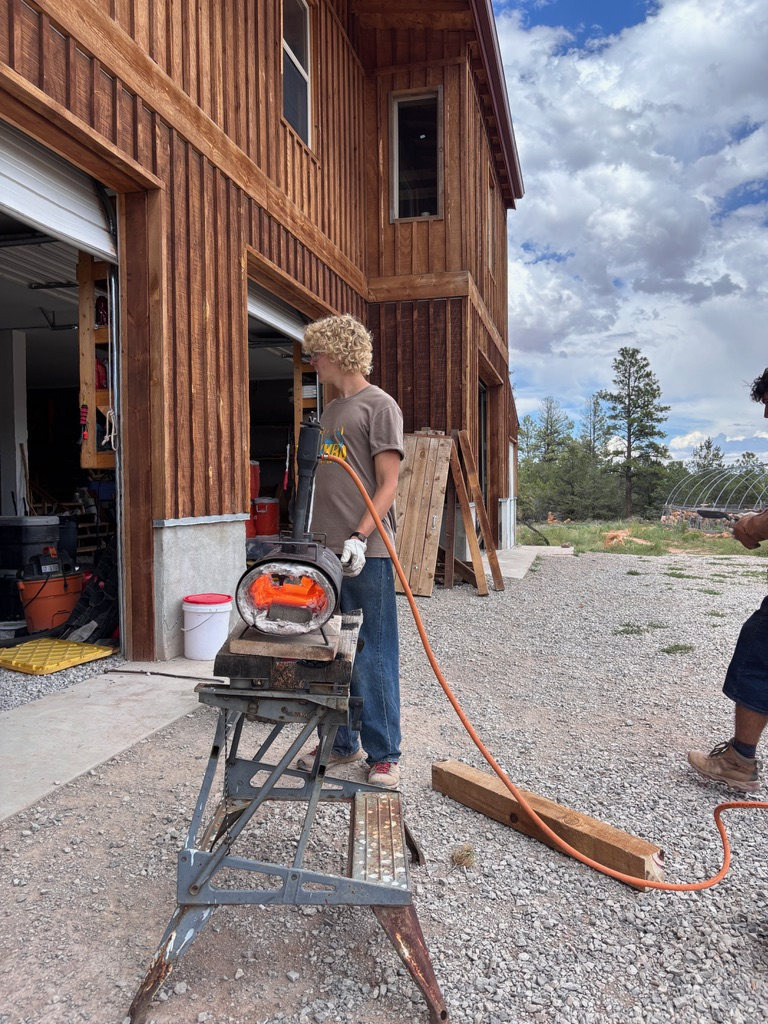
The next step was quenching, which hardened the blade. To do this, I heated the entire thing and then immidiately dipped the blade in an oil bath. The rapid cooling locked the steel into a more rigid crystal structure. This took a couple tries, as the blade was only just barely small enough to be heated along its length by the forge.
To make the handle, I cut a chunk out of an elk antler I found on a different backpack. I then cut the (hardened, annoyingly) blade into a tang, which is a spike used to ram it into the handle. I drilled a starter hole into the antler, and drove the tang into the softish marrow. I lightly toasted the outside of the antler to bring out its texture and used epoxy to seal the whole thing.
This was a highly instructive process, and I think I could repeat it by myself if I had the resources. I learned a lot about how knives are made and gained a greater appreciation for the artisanship involved.